

ASHBi Overseas PI system allows a Principal Investigator based at an overseas university or research institution (Overseas PI) to recruit a talented young researcher as a Co-PI at ASHBi to jointly manage a research group. Through this system, Overseas PIs can establish and lead satellite laboratories at ASHBi while maintaining their primary research groups abroad, with their Co-PIs overseeing on-site management in Kyoto. To further enhance the infrastructure for hosting these PIs’ labs, plans are also underway to construct a new building in collaboration with the Graduate School of Medicine.
About Oversea PI
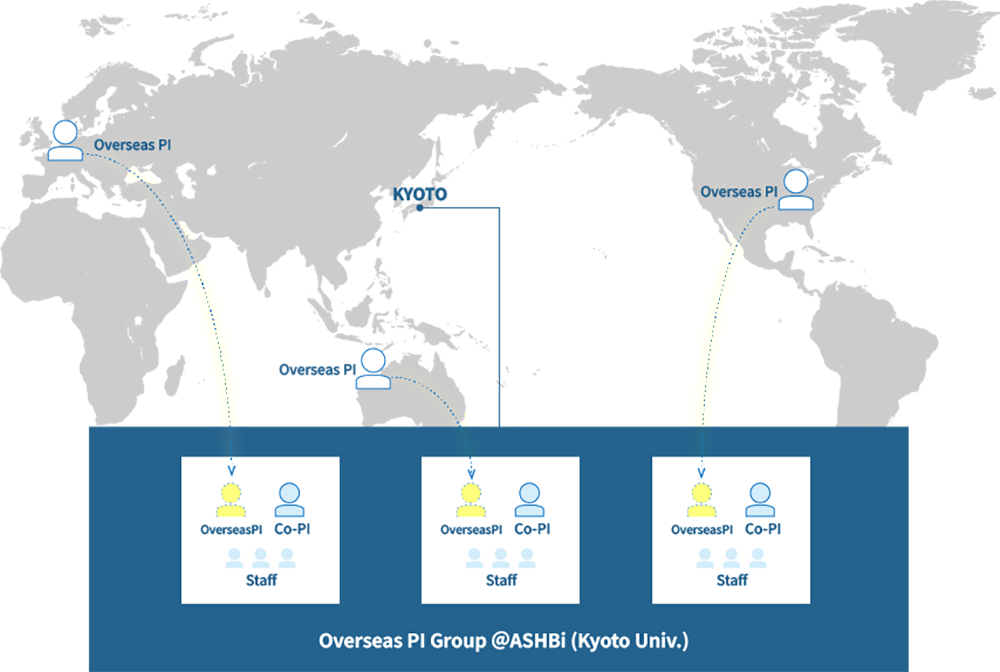
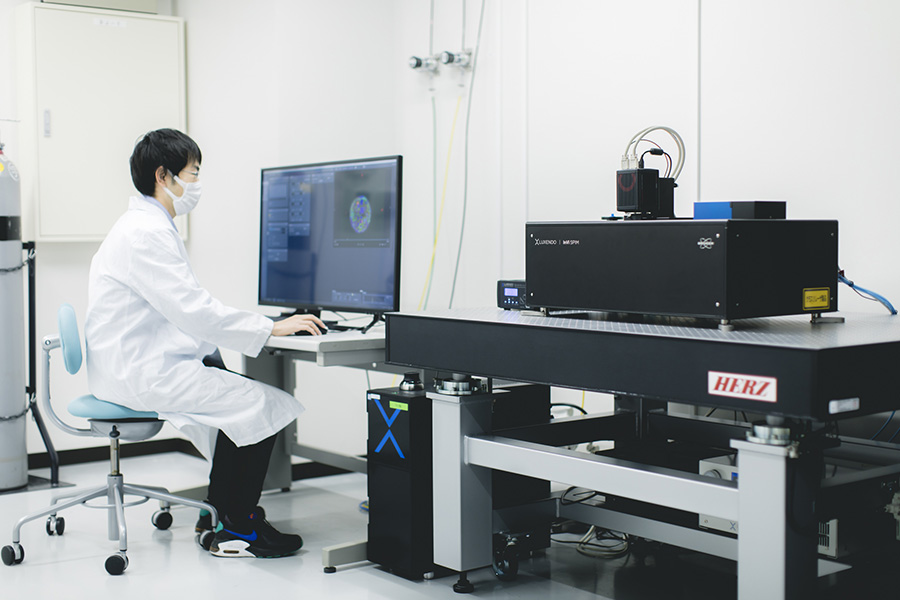
As an ASHBi Principal Investigator, an Overseas PI can lead and manage a research group in close collaboration with a dedicated Co-PI based in Kyoto. The recruitment of the Co-PI will be conducted in accordance with the Overseas PI’s preferences, with support from the ASHBi Global Research Acceleration Unit. Upon request, ASHBi can also introduce potential Co-PI candidates to facilitate the process. Research space is provided on the Kyoto University Faculty of Medicine campus, offering full access to the state-of-the-art shared research facilities of both ASHBi and the university.
| Job Title | Distinguished Visiting Professor |
|---|---|
| Term | Initial term of X years, followed by renewals every X years. |
| Salary | Annually XXX JPY |
| Eligibility | Principal Investigators (PI) who lead a research laboratory at an overseas university or research institution and possess a strong motivation to establish and operate a satellite laboratory at ASHBi (Kyoto) over a long-term period. |
| Financial Support from ASHBi | Travel and Accommodation: Travel and stay expenses for visiting Kyoto (up to X times per year). Start-up Funding: XX JPY per year for the first two years. Personnel Support: Funding for one Co-PI and one Postdoctoral Researcher. |
| Key Job Responsibilities | Remote Laboratory Management: Manage the laboratory remotely in coordination with the Co-PI. Visits to ASHBi: Visit ASHBi approximately 1 – 3 times per year, including attendance at the WPI Site Visit (Summer) and the ASHBi Retreat (Winter). |
About Co-PI
A Co-PI will jointly lead a research group together with an overseas PI. Supported by the Global Research Acceleration Unit, the Co-PI is expected to take the lead in laboratory setup and daily operations in coordination with the overseas PI. The Co-PI will be eligible for various institutional support services, including research publication consultation service.
| Job Title | Program-Specific Senior Lecturer or Program-Specific Associate Professor |
|---|---|
| Term | Same as the term of the Overseas PI |
| Salary | Annually XXX JPY |
| Key Job Responsibilities | On-site Laboratory Management: Responsible for the local management of the laboratory at ASHBi Institutional Duties: Attending institutional meetings and fulfilling duties as a faculty member. |
| Ideal Candidate | Researchers who are well-acquainted with the Japanese academic system (e.g., by having completed a Ph.D. program at a Japanese university or research institution). ASHBi seeks young researchers who possess a strong motivation to learn international-standard laboratory management from an overseas PI, with the goal of independently managing their own laboratory in the future. |
ASHBi Oversea PI Group (Bourque Group)
| Overseas PI: Guillaume Bourque | Expertise: Comparative Genomics |
|---|---|
| Background: Leading a “dry” laboratory specializing in bioinformatics at McGill University (Canada). In this system, he provides oversight and expertise in computational genomics from his home institution. | |
| Co-PI: Fumitaka Inoue | Expertise: Genomics and Molecular Biology |
| Role: Leading the “wet” experimental laboratory at ASHBi as part of the Bourque Group (Inoue Lab). He manages the daily operations and focuses on molecular biology-driven research. |
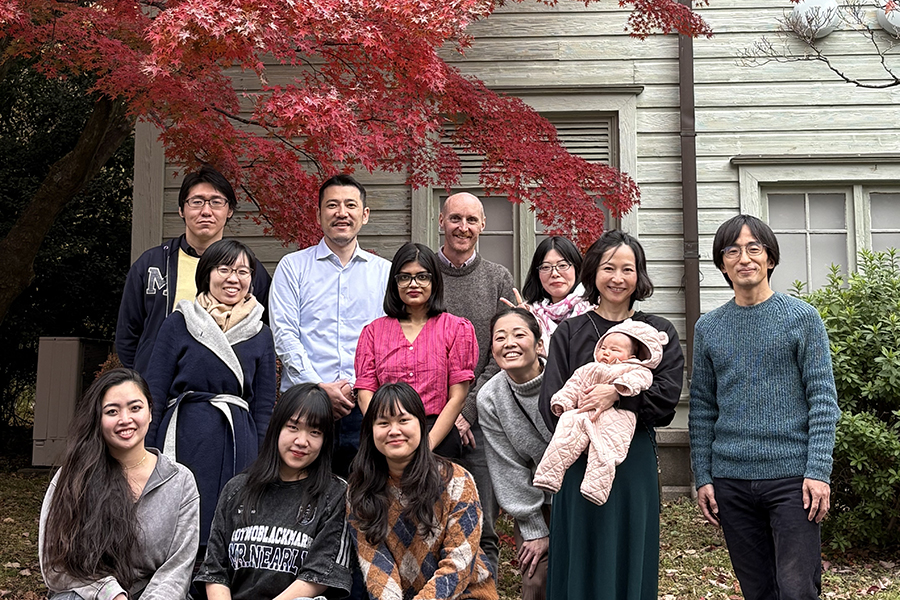
VOICE (Bourque PI)
Q: How much time do you spend in Kyoto each year?
A: My schedule is flexible, but I typically visit Kyoto two to three times a year for several weeks at a time. I make it a priority to sync these visits with key events such as the WPI Site Visit and the ASHBi Retreat whenever possible.
Q: How frequently do you communicate with members at ASHBi?
A: During the initial startup phase, we held online meetings almost every week. Now that the lab is established, we conduct online progress reports about once every two weeks. For projects specifically led by the Co-PI, I use my in-person visits to Japan to catch up on the finer details and have deeper discussions.
Q: How does the Co-PI system work for your laboratory?
A: I rely on the Co-PI to manage the day-to-day operations and to lead efforts in securing external research funding for the ASHBi lab. While we share the same research interest, our areas of expertise are slightly different, and this allows us to complement each other’s strengths. Furthermore, having a Co-PI who is deeply familiar with the Japanese system ensures that everything—from administrative logistics to experimental protocols—proceeds seamlessly.
Publications from ASHBi Bourque Group
Zhang, Z., Georgakopoulos-Soares, I., Bourque, G., Ahituv, N., and Inoue, F. (2026). Simultaneous epigenomic profiling and regulatory activity measurement using e2MPRA. Nature Communications. https://doi.org/10.1038/s41467-026-68422-3
Chen, X.^, Zhang, Z., Yan, Y., Goubert, C., Bourque, G.^, and Inoue, F.^ (2025). A phylogenetic approach uncovers cryptic endogenous retrovirus subfamilies in the primate lineage. Science Advances. https://doi.org/10.1126/sciadv.ads9164.
Groza, C., Chen, X., Wheeler, T., Bourque, G. &Goubert, C. (2024). A unified framework to analyze transposable element insertion polymorphoisms using graph genomes. Nature Communications. https://doi.org/10.1038/s41467-024-53294-2
Chen, X., Pacis, A., Aracena, K. A., Gona, S., Kwan, T., Groza, C., Lin, Y. L., Sindeaux, R., Yotova, V., Pramatarova, A., Simon, M. M., Pastinen, T., Barreiro, L. B., & Bourque, G. (2023). Transposable elements are associated with the variable response to influenza infection. Cell Genomics. https://doi.org/10.1016/j.xgen.2023.100292