

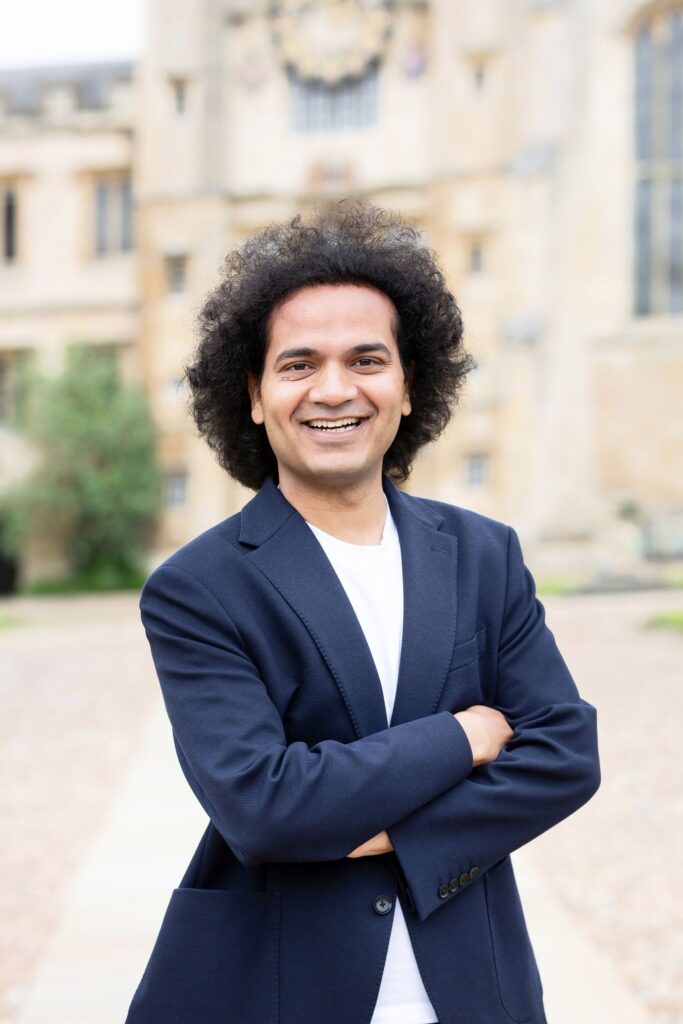
Abhishek Upadhyay
| Position | Program-Specific Researcher |
|---|---|
| Group name | Seirin Group |
| Research Field | Systems Biology |
| ORCID | https://orcid.org/0000-0003-0046-1168 |
| Personal Website | https://scholar.google.com/citations?user=wSkyhD4AAAAJ&hl=en |
| Joined | 2026/01/16 |
Research Overview
Dr. Abhishek Upadhyay, a visiting researcher at the University of Cambridge, stands as a rare polymath in systems biology, with a research trajectory that systematically decodes the logic of signaling and clocks across the kingdoms of life and maps the temporal architecture of life from single-celled organisms to humans.
Biology in time and space: from Amoeba to Humans
Amoebae: At IISc Bangalore, he conducted experiments to investigate the evolutionary transition from unicellularity to multicellularity, how social amoeba coordinate collective behavior via cyclic AMP signaling – a precursor to complex biological timing.
Oysters: At the University of Hong Kong, his MPhil research utilized mesocosm experiments to study how ocean acidification impacts shell protein formation, biomineralization, in intertidal oysters.
Fungi: In a remarkably concise 24-page theoretical PhD thesis at Humboldt University of Berlin, in collaboration with Heidelberg University, he employed mathematical modeling to define the molecular switches that generate 24-hour circadian rhythms in filamentous fungus.
Worms: During his time at Novartis and FMI-Basel, he combined time course experiments with computational tools to discover an oscillatory phosphoproteome that drives developmental timing in roundworms.
Plants: At the University of Cambridge, he developed the first data-driven quantitative models for the wheat circadian clock by integrating experimental data and performing parameter optimization.
Humans: In Kyoto, his research focuses on the human embryonic clock that emerges at the time of birth.
Biography
Abhi is a visiting researcher at the University of Cambridge and an Affiliate of Trinity College. For the latter he was nominated by 2019 Nobel Laureate Didier Queloz, a renowned Swiss astronomer and Fellow of the Royal Society.
With a global academic background, Abhi earned a bachelor’s degree in biotechnology engineering in India, a research-based experimental master’s in marine biology in Hong Kong, and a computational PhD in systems biology in Germany, followed by professional experience in Switzerland and UK.